
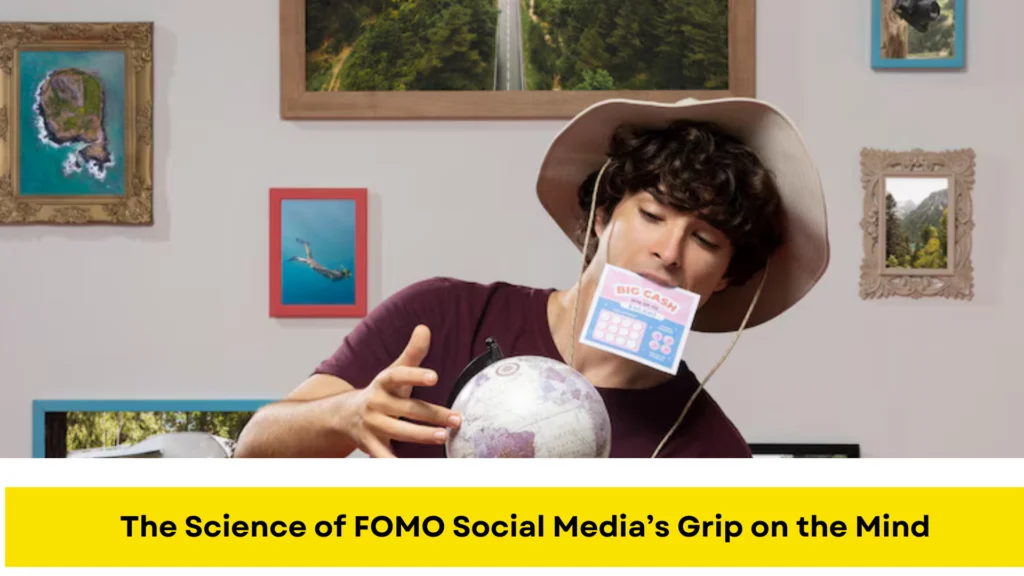
In this article, psychologist Kira Guerra Franco and psychotherapist Ivn Baliimil Rodriguez-Valcarce talk about how using social networks can lead to FOMO (Fear of Missing Out), a social anxiety disorder that affects millions of people who want to be online all the time to avoid missing out on anything in the digital age. Have you ever seen pictures of a party you didn’t go to and wished you had gone? You might have worried about missing out on the best party of your life when you saw the photos on Instagram, showing the science of FOMO in action.
Social media has changed the way we interact, talk to each other, and see the world in a big way, especially in the digital age (Díaz & Extremera, 2020). The spread of information and communication technology (ICT), especially in digital form, has made some psychological problems, like FOMO, increasingly common. Dan Herman came up with the term, and Przybylski et al. made it widespread. It defines the sensation of anxiety that happens when someone thinks that other people are going through something they are not (Torres Serrano, 2020; Gupta and Sharma, 2021).
If this has happened to you, you probably have FOMO
So, it shows a need to always know what other individuals are doing (Przybylski et al., 2013). It can be a short-lived feeling that comes up during a fight, a long-term disease, or a mental state that shows even stronger feelings of social inferiority, loneliness, or wrath in the person (Gupta and Sharma, 2021). FOMO has been around for a long time, and it’s not simply a problem with social media. However, the rise of social media has made this worry even worse. This phenomena has effects on more than just the people who go through it; it also has effects on society as a whole.
Because social media has changed the way we communicate, seeing carefully chosen and manipulated pictures of other people’s lives can lead to false ideas about what it is to have a happy life (Braña S S. a. Moral Jim eez, 2023). Teenagers, who want things right away, have a hard time breaking this pattern (Wu et al., 2013).
Reward Pathway
They use commercial algorithms. In the most recent version of Influence (2021), Robert Cialdini talks about how these algorithms work utilizing the ideas of persuasion, reciprocity, and intermittent reinforcement. This attitude about algorithms is affecting more than just individuals; it’s affecting society as a whole.
Customizing the material could produce polarization and information bubbles (Todorovich, 2021), which could hurt social cohesion and make groups break up. Also, the way this modification works shows how shallow acts and social comparison hurt people’s self-esteem, especially young people (Vogel et al., 2014).
The brain is very flexible
Teenagers use these sites as a way to try out new ways of connecting with others and expressing themselves in order to learn more about themselves and figure out who they are. Because of FOMO, people start social networks, and the drive to find their digital identity leads to too much information about events and activities. Social pressure and internet validation may also make them act all the time.
Because the FOMO effect is still fresh, research results about all brain areas and cognitive processes are still not clear. But studies show that when people feel left out, their anterior cingulate cortex (ACC), insula, and dorsolateral prefrontal cortex (DLPFC) are activated (Eisenberger et al., 2003, 2007; Burklund, Eisenberger, and Lieberman 2007; DeWall et al., 2010; Kross et al., 2007, 2011; Chester, DeWall, and Pond 2016).
Conclusion
The intensity of the discomfort that may be brought on by FOMO is indicated by the stimulation of this area of the brain in response to physical pain and social exclusion. It is also a component of conflict assessment and affective processing. On the other hand, the insula is very important for interoception, which is the ability to feel the body’s internal sensations. When it is activated during social exclusion, the negative reaction is worse (Eisenberger et al., 2007). FOMO is connected to both how we think and how we control our emotions in a more general sense.
There is so much information and so much to keep an eye on in the outer world, especially the digital realm, that it is hard to focus on anything else (Shanmugasundaram & Tamilarasu, 2023). There is little question that when someone has a satisfying social relationship, their dopaminergic pathways, especially their mesolimbic systems, are active (Gupta and Sharma, 2021; Todorovich, 2021). Also, encoding prediction error in reward prediction and its variations keeps these behaviors going. FOMO hurts people’s social and emotional lives.